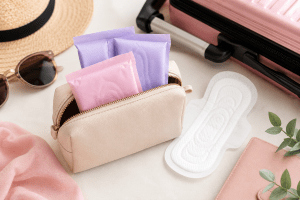
Travel-Friendly Sanitary Pads: Stay Comfortable and Confident Wherever You Go
It can seem difficult to travel on your periods. If you’re traveling to work, going

Your menstrual cycle isn’t just about bleeding dates; it’s a full-body process run by hormones, metabolism, and internal rhythms. One of the most obvious yet frequently overlooked cues is body temp on period.
These small changes might let you know when your body is ovulating, why it feels warm before your period, and even if your hormones are all working together.
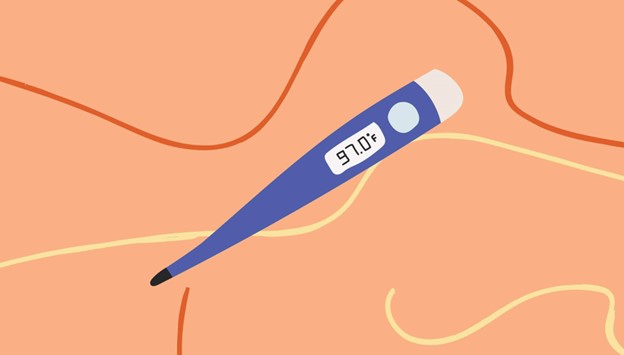
Body temperature menstrual cycle is important to know in order to take care of yourself. Estrogen and progesterone levels rise and fall throughout the month, directly influencing how your body regulates heat. These differences are slight but also reliably noticeable, and so helpful in knowing what’s going on with your cycles.
When tracked daily, these ups and downs create a rhythm known as basal body temperature (BBT), which shows your body’s resting temp.
Among other causes, the body temperature may vary for the following reasons:
Menstruation: This is the time when estrogen and progesterone are at their lowest levels. In turn, your body temperature during the period tends to bounce back down to baseline or a bit lower than normal.
During this phase, many people experience physical changes like being more tired or feeling colder. Heavier flow days also often prioritize comfort, so more absorbent options like maxi pads may be favorable.
Other symptoms are:
After your period is over, estrogen starts to increase. This hormone has a cooling effect that keeps your temperature stable and slightly lower than average.
This stage tends to be marked by increased focus and energy. It serves as a tracking reference for what is to be seized when future temperature changes occur.
In most instances, the temperature trends are as follows:
Ovulation does not itself bring about a rise in temperature. The spike doesn’t occur until after ovulation, when the body starts releasing progesterone instead. That’s why temperature monitoring confirms that ovulation has already taken place.
What usually happens around ovulation:
This phase responds to a frequently asked question: why does body temperature increase before period? Yes, it does.
The dominant hormone becomes progesterone, which increases your core temperature and keeps it elevated until menstruation arrives.
You may notice:
So in case you were ever wondering, does your period raise your temperature? The answer is that progesterone does, right before your period begins.
When pregnancy doesn’t take place, progesterone levels drop. The drop in these hormones results in body temperature siding back down.
This change generally occurs one to two days before you start bleeding and is considered one of the most dependable signs that your period is on its way.
Signs of this transition include:
Hormones are the big players in temperature fluctuation across your cycle. Each hormone has its own role in control of heat.
Estrogen typically:
Progesterone typically:
In a normal cycle, these two hormonal phases are quite distinct.
Sometimes, yes, abnormal patterning can signal that hormones aren’t doing what we expect. While monitoring temperature is not a diagnostic tool, it can sometimes detect variations in the locations to notice.
Irregular patterns may include:
However, if this continues, see a professional for an assessment.
Monitoring temperature verifies whether ovulation is happening regularly.
Temperature trends can indicate:
But temperature tracking is most useful in combination with other health indicators.
Hormones are not the only things that cause changes in temperature. Readings too can be affected by external and lifestyle factors, which should also play a role in monitoring.
Common factors include:
When measurement time and conditions are consistent, greater accuracy can be achieved.
The normal body temperature ranges from 96°F to 99°F.
During menstruation, reduced levels of estrogen and progesterone decrease the body’s temperature to normal, which the body perceives as feeling cooler.
Yes, on-and-off temperature shifts could indicate ovulation or progesterone problems.
Thus, progesterone increases metabolic heat and results in a rise in body temperature that is constant.
It may help to assess the repeatability of ovulation and luteal phase duration, but patients need to use it with regular monitoring.
When pregnancy doesn’t happen, progesterone levels drop, leading to a decrease in temperature and the start of menstruation.
Yes, stress, fever, lack of sleep, and being ill can all affect readings.
Run it consistently over a few cycles, and it’s a reliable pattern-recognizing tool.
Yes, a fall in temperature following raised temperatures does often indicate the beginning of a period within one or two days.
Your body temperature is a silent symptom of what’s happening below the waterline of your menstrual cycle.
Once you understand these patterns, you can achieve more clarity, confidence, and control over your menstrual health, without having to play the guessing game.
It can seem difficult to travel on your periods. If you’re traveling to work, going

Heavy Periods can be tough to manage. Nobody wants to be standing at work or
A good night’s sleep is possible with the right pad only! Nothing interrupts the peaceful
A good sanitary pad can be the difference between a comfortable day and being miserable.
It can seem difficult to travel on your periods. If you’re traveling to work, going
Heavy Periods can be tough to manage. Nobody wants to be standing at work or
A good night’s sleep is possible with the right pad only! Nothing interrupts the peaceful
A good sanitary pad can be the difference between a comfortable day and being miserable.